The Idea
What would it look like if we replaced all federal taxes with a single, proportional wealth tax?
No income tax. No payroll tax. No corporate tax, estate tax, capital gains tax, or any of the other federal levies. One tax. One rate. One ledger.
The design rests on four pillars:
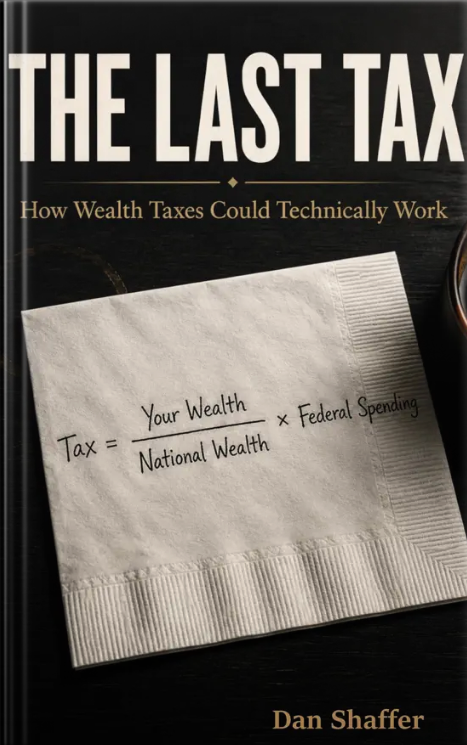
One Tax. A single proportional wealth tax replaces every federal tax currently collected. The Internal Revenue Code, its Treasury regulations, and the seventy-thousand-page tax-research library built around them all become obsolete. In their place: a formula simple enough to fit on a napkin. Your tax equals your share of the nation's wealth multiplied by federal spending. That is it. All wealth is taxed annually, the same way property taxes work on land. The system does not distinguish between realized and unrealized gains, or between earned and unearned income. You control it, you pay on it.
One Ledger. A public record of all wealth, who controls it, and what they owe. Think of county land records, which have tracked property ownership for centuries. Now extend that principle to all forms of wealth: stocks, bonds, business equity, intellectual property, cryptocurrency, art, vehicles, and everything that can be exchanged, valued, and transferred. The ledger is the authoritative record. Registration is the strongest claim to ownership the system offers.
One Principle. Those who control wealth pay proportionally to what they control. Not based on income, which can be manipulated, deferred, and hidden, but on control. If you can direct an asset, benefit from it, exclude others from it, or transfer it, you bear the duty to pay your share. This is the "duty of control," and it follows the wealth wherever it goes, through whatever structures are placed around it.
One Consequence. The incentive structure inverts. Today, hiding wealth is advantageous: the concealed asset is off the tax rolls and still yours. Under this system, hiding wealth means risking that someone else registers it first and holds the superior claim. If you control wealth above the de minimis threshold, you register it. If you do not, anyone else with evidence of control can. Chapter 7 details how the ledger works, including thresholds and how competing claims are resolved.
This sounds radical. But is it?
Property taxes already work this way for real estate. You declare your property. The county assesses its value. You pay a percentage annually. If you do not pay, the county sells your property to someone who will. The wealth stays in the tax base; only the owner changes. Across the United States, counties routinely identify assets, assess their value, and collect taxes on them. The methods vary from state to state, but the capability is universal.
What this book describes is an extension of that proven principle to all forms of wealth. The technology to do so now exists. The question is whether we have the will to use it.
Why This Book, Why Now
Three developments make this idea timely in a way it has never been before.
The current system is broken beyond repair. The federal tax system nominally collects about $5.1 trillion per year, but the "tax gap" (the difference between what is owed and what is collected) runs to $696 billion annually in gross terms, with roughly $606 billion never recovered even after enforcement. That is not a bug; it is a feature. The system is designed to be gamed by those with the resources to game it.
The numbers are stark. ProPublica's analysis of leaked IRS data showed the 25 richest Americans paid a true tax rate of just 3.4% between 2014 and 2018 (Chapter 2 provides the individual figures). Meanwhile, a nurse or a teacher earning $60,000 pays 20-30% when you include income and payroll taxes.
The system appears progressive when measured by income. The top 1% paid an average federal income tax rate of 23.1% on reported adjusted gross income. But the wealthy do not have "income" in the legal sense. They have wealth appreciation. Their stocks go up. Their companies grow. Their real estate appreciates. None of this is taxed until they choose to sell, and many never need to sell a share in their lifetime. They borrow against their assets, live on the loans, and when they die, the gains disappear. This is the "buy-borrow-die" strategy (Chapter 2 details the mechanics), and it is perfectly legal.
The tax code is not failing. It is working exactly as designed, for those who designed it.
Technology accidentally solved the implementation problem. For most of history, a comprehensive wealth tax was impractical. How do you track all the wealth in a nation? How do you prevent people from hiding assets? How do you value things that are not publicly traded? The answer is blockchain.
Blockchain is unfamiliar to most people. Three things matter:
- Things have identities. A traditional ledger tracks money moving between accounts. This person paid this amount for this thing, new balance, next line, repeat. Blockchain adds something new: the objects being exchanged have identities on the ledger too. That object could be a house, a share of stock, a piece of art, or a fraction of one. This makes it possible to trace the complete ownership history of anything, not just the flow of money.
- No single person controls it. When ownership changes hands, the transaction is announced simultaneously to thousands of independent ledger-keepers. No single party can silently add to the ledger, because any change is immediately visible to everyone else.
- The past is arithmetically protected. Each entry is mathematically linked to the one before it, like a chain. Change anything in the past and you corrupt every entry that follows, making it glaringly obvious which record was tampered with.
The result is a tamper-evident history of who owns what, verified by math rather than trust.
Blockchain idealists set out to circumvent the powerful. They wanted to create money and property systems outside government control. In the process, they built something unexpected: high-volume, tamper-evident, distributed ledger technology capable of tracking ownership at massive scale.
The technology built to escape government accountability can be repurposed to enable it. The tools exist, already processing millions of transactions daily with immutable records and cryptographic verification. The wealthy may have captured cryptocurrency as a means of banking in the dark (a way to hold assets beyond taxation and regulation), but in the process they created the very tools needed to track and tax the wealth they were trying to hide.
What was impossible in 1913, when the income tax amendment was ratified, is routine today.
The political window exists. Wealth inequality has reached levels not seen since the Gilded Age. The top 1% now controls roughly a third of all US wealth, more than twelve times what the bottom half of households hold combined. Chapter 3 examines what this concentration means for republican government. Public frustration with a "rigged system" spans the political spectrum from progressive Democrats to populist Republicans. The sense that the rules are different for the powerful is widespread and accurate.
The 16th Amendment precedent (Chapter 2 tells the full story) proves that Americans can restructure federal taxation when the need is clear. Movements start with understanding. This book provides that understanding.
The government goes first. Before asking any citizen to declare their wealth on a public ledger, the system described in this book puts federal spending on the same kind of ledger. The Pentagon has failed its financial audit eight consecutive years, running 208 systems relevant to its financial audit that cannot be reconciled into a single audit trail. A tamper-evident spending ledger solves that problem and proves the technology at scale. If the government will not submit to the transparency it asks of citizens, it has no standing to ask. Chapter 14 details how this works.
What This Book Will Show You
This book is organized into four parts.
Part I: The Problem (Chapters 2-4) traces how the current tax system evolved from simple tariffs to the labyrinthine code we have today. It explains why the system punishes work while rewarding wealth accumulation, and why incremental reforms to "close the loopholes," "raise the rates," "fund the IRS" keep running into structural problems.
Part II: The Design (Chapters 5-9) walks through each component of the system. What counts as wealth? Who bears the duty to pay? How would the ledger work? What is the formula? How is it enforced? Each chapter addresses one component with concrete mechanisms, not vague aspirations.
Part III: Hard Questions (Chapters 10-13) takes on the strongest objections. "It's unconstitutional." "You can't value everything." "The rich will just leave." "What about privacy?" These are serious concerns, and they deserve serious responses. You will find them here.
Part IV: Implementation & Action (Chapters 14-16) explains how we get from here to there. What is the transition plan? What does this mean for you personally? What would it take to make it happen?
You can read straight through, or jump to what interests you most. Skeptics might start with Part III. Numbers people will find detailed calculations in Chapter 8. If you want to know what this means for your own situation, Chapter 15 has worked examples at every wealth level.
The Core Question
Here is the question this book tries to answer:
Can we build a tax system where those who control the most wealth pay proportionally to support the civilization that makes that wealth possible, and where the technology exists to actually enforce it?
"Taxes are the maintenance fee for civilization." Roads, courts, police, contracts, property rights, national defense, public health, education: all require funding. Wealth itself only exists because society enforces it. Your ownership of a house means nothing without courts to adjudicate disputes, police to prevent theft, and a legal system that recognizes your title. Your ownership of stock means nothing without securities laws, contract enforcement, and a stable currency. Wealth is built inside a social infrastructure, and that infrastructure has to be maintained.
"Those who control the most should pay proportionally." The tax is proportional, not punitive. Whether the wealth is one million dollars or one billion, the rate is the same; only the dollar amount changes. Those who benefit most from the infrastructure of civilization and whose wealth depends most heavily on courts, contracts, and stability should contribute most to maintaining it. This is not redistribution; it is contribution.
"Technology now makes this enforceable." The practical objection to wealth taxation has always been enforcement. How do you know what people own? How do you prevent concealment? How do you value illiquid assets? These were genuine obstacles in 1913. They are not obstacles today. Distributed ledger technology can track hundreds of millions of assets. Cryptographic signatures can verify ownership. Tamper-evident records can prevent manipulation. The infrastructure exists; it needs only to be applied to civic purposes.
"The ledger captures wealth we cannot even see today." When this book refers to "national wealth," it uses the Federal Reserve's estimate of US household net worth: roughly $175 trillion. But that figure only counts what American households own. It excludes tens of trillions of dollars controlled by foreign individuals, foreign corporations, and foreign governments holding assets within US jurisdiction. The ledger does not care about passports. If you control wealth in the United States, you register it and bear the duty, or someone else can. When foreign-controlled wealth enters the ledger, the denominator grows substantially, and the effective tax rate falls. The 4% rate cited throughout this book is based on conservative assumptions; the true rate could be closer to 3%. Chapter 8 works through these numbers in detail.
A Note to the Reader
This book is written for anyone who pays taxes, which is to say, nearly everyone. It does not assume expertise in tax law, blockchain technology, or constitutional history. Where technical concepts are necessary, they are explained. Where numbers are used, they are sourced.
The author brings more than fifteen years of data engineering experience across private industry, ecommerce, and government. This is not an economist's thought experiment or a politician's platform; it is an engineer's design, built from the perspective of someone who has spent a career designing systems that track, value, and move data at scale. The question that drives this book is the same one that drives any engineering project: Can we build this?
If you are skeptical, good. Skepticism is the right response when someone describes replacing the entire federal tax system. Read the hard questions chapters. Check the sources. Do the math yourself. Chapter 8 gives you the formula.
If you are already convinced that the system is broken, this book offers something beyond outrage: a concrete alternative. Not "tax the rich" as a slogan, but a specific mechanism for how it could work in a way that cannot be evaded.
If you are wealthy, you may find this idea threatening. Or you may find it liberating. A system where everyone pays their share, including you, is also a system where no one can accuse you of cheating. The ledger is public. Your contribution is visible. The social contract is honored by all.
Whatever your starting point, the goal is the same: to understand what is possible, and to decide what to do about it.
What This Means in Practice
Consider one person.
Maria teaches fourth grade. She earns $58,000 a year and has $117,000 in total wealth: modest savings, a retirement account, a paid-off car. Under the current system, she pays approximately $13,700 in federal taxes, including income tax, her payroll tax, and the employer payroll tax that suppresses her wages before she ever sees a job offer (Chapter 2 explains this hidden cost). That is 24% of her income.
Under the wealth tax: $117,000 times 4% equals $4,680. Maria saves $9,020 per year. Not because anyone gave her a tax cut, but because the system stopped taxing what she earns and started taxing what people control.
At the other end: a billionaire controlling $8.3 billion currently pays about $25 million in federal taxes, an effective rate of 0.3% on his wealth. Under the same formula: $8.3 billion times 4% equals $332 million. The rate is identical. The amount differs because the wealth differs.
Chapter 15 walks through twelve detailed profiles at every wealth level, from a working family earning $48,000 to a billionaire, with full asset tables and side-by-side comparisons. The crossover point, where the wealth tax equals current federal taxes, falls at roughly $1.5-2 million. Below that, approximately 88-90% of American households pay less.
What Comes Next
The next chapter traces how we got here, how a nation founded on opposition to taxation developed the most complex tax code in the world, and how that code came to serve the interests of those it was meant to constrain.
But first, a preview of where we are going.
The system described in this book would:
- Replace every federal tax (income, payroll, corporate, estate, and capital gains) with a single proportional wealth tax (approximately 4% based on conservative estimates, potentially as low as 3% once all wealth is captured on the ledger)
- Record all wealth on a public ledger with tamper-evident verification
- Make tax liability automatic and transparent: no returns, no withholding, no quarterly estimates
- Protect homeowners and retirees: no one loses their home for lack of cash flow
- Require a constitutional amendment to implement (as the income tax did)
- Build in 4-6 years at a cost of $2-5 billion (a fraction of current IRS costs)
- Generate revenue equivalent to the federal budget, matching current levels, while closing the tax gap and distributing the burden proportionally
Every dollar of wealth as visible as every acre of land. Every citizen's contribution proportional, transparent, and automatic. That is the system this book describes. That is the system we could build.